Friday, January 20, 2012
Hot Air
“Just as it would not be Chinle without horses grazing at the intersection, it would not be Bluff without herds of sheep and goats meandering the mission road”, Jana said, shaking her head in wonder. To be sure, there are certain things that define our small town, and wooly livestock that bleat and bawl is one of them. Another is the Bluff International Balloon Festival.
Last Friday, Saturday and Sunday was the 14th annual event, and, as always, it was memorable. On Friday and Saturday the pilots, 25 in all, flying balloons with names like Basketcase, Skywalker, Breezy Rider and Levity, launched in Bluff. On Sunday, the balloons lifted off from Valley of the Gods.
As the brightly colored, hot air fueled inflatables meandered through our red rock landscape on slow currents of chilly air, I was reminded of our first festival. At that celebration we had but one balloon. The pilot, who had been invited to come test the waters, elected to put up in Valley of the Gods. A half dozen Bluff residents, hopeful the flyer would enjoy our town enough to return with his friends, tagged along. As the balloon probed the spires of the valley, hopping from one to another, the Bluff citizenry stood by. In their faces the excitement and anticipation shown brightly. Each was anxious to hear what the balloonist would say when he landed. “Fantastic, beautiful, extraordinary,” he exclaimed as he put down, echoing the emotions we all held for this rugged land. It was then we knew we might have a winner.
The following January more balloons arrived and the festival began to grow. That year as I stood next to a basket awaiting directions to climb in for my maiden voyage, out of the corner of my eye I spotted a fast moving object.
It turned out to be Fran, one of our friends from Bluff, who had decided she could wait no longer to go up. Having made that decision, she threw caution to the wind. Seeing her heading directly for me with head down and arms waiving, I sidestepped just in time to miss being bowled over as she tumbled headfirst into the basket. As she tumbled in, she shouted, “Outta’ the way, I have always wanted to go up in one of these things.”
Once my surprise subsided, I had to admit to being thoroughly impressed with the agility and determination of this sixty-something woman. Everyone agreed Fran would not and should not be dislodged, so the pilot put gas to burner and up they shot; his passenger smiling so broadly she resembled the Cheshire Cat.
Although I had to wait until the following year for my inaugural flight, I have now flown on several occasions, with a variety of pilots. Each time I marvel at the peaceful feeling that washes over me as we sail slowly over these ancient sandstone reefs with the magnificent people who fly those magnificently awkward contraptions.
With warm regards,
Steve, Barry and The Team
Great New Items! This week's selection of Native American art!
Our TnT's purchased new treasures! Check out Traders in Training!
Enjoy artwork from our many collector friends in Living with the Art!
Monday, February 08, 2010
1970s Natural Gem Grade Morenci Turquoise Cluster Ring

1970s Natural, Gem Grade Morenci Turquoise Cluster Ring
This classic, sterling silver and turquoise cluster ring contains 32 miniature cabochons of high-grade natural Morenci. Because of its value and rarity, this quality of turquoise is rarely found in modern jewelry. This is the type of wearable art that was often seen displayed on the Navajo people themselves.
Friday, January 08, 2010
Navajo Persian Turquoise Cluff Bracelet by Victor Begay

Navajo Persian Turquoise Cuff Bracelet
Victor Begay is considered an old master in the world of Navajo jewelry; he creates wonderful collector pieces using amazing examples of exotic turquoise. This large, gorgeous, green stone with light yellow matrix captures my imagination. Big, heavy cuff bracelets are generally uncomfortable to wear; not so with one-piece flat cuffs like this one. This style of bracelet is a pleasure to wear, because it fits the wrist so closely. Victor's stamp work is clean and precise, and he has produced an aged effect with the aid of oxidation and gentle buffing. This bracelet would be a welcome addition to any museum collection.
Friday, August 07, 2009
Navajo Monument Valley Mitten Basket by Joann Johnson

Navajo Monument Valley Mitten Basket
This wonderful basket by acclaimed Navajo artist Joann Johnson depicts a "laid back" representation of Monument Valley. The panoramic view of the valley is as if you were lying on the warm desert sand looking up at the moon lit and star filled sky. The perspective from the midst of the massive mitten monoliths and sky world of the Navajo people is truly impressive. With this basket Joann presents a unique vision and masterful composition of her beloved homeland.
Thursday, July 23, 2009
Navajo Triple Yei Weaving by Luana Tso

Navajo Triple Yei Weaving by Luana Tso.
The Yei-be-chei of the Navajo people are believed to ward off sickness, disease and psychological imbalance. This spectacular weaving shows three massive Yei figures and portrays the guidance and protective forces of these supernatural beings. From the creative mind and masterful hand of Luana Tso comes a magnificent textile born of Navajo traditions. Rich depth of color and strong graphic detail combine to make an impressive weaving. Collectible? Absolutely!
Monday, July 06, 2009
Navajo Midnight Changing Woman Basket

Navajo Midnight Changing Woman Basket.
Changing Woman is one of those Wonderful Navajo deities that wraps herself around you and grants the guidance and protection necessary for a harmonious life. If she is allowed into your world she will use her incredibly positive, benevolent influence to guard you from harm and accident - anytime, anywhere! Elsie Holiday's representation of Changing Woman at Midnight presents this masterful weaver's belief of her own personal guardian angel when she needs her the most. Sleep well, Elsie!
Wednesday, June 24, 2009
Navajo Coyote Story Collage Basket by Peggy Black

Navajo Coyote Collage Basket
Talk about your cultural expressions, Peggy Rock Black has packed it all into this piece. You will find within this basket a tale of greed, jealousy and revenge; another of trickery and judgment; a metaphor for chaos and order; a tall tale of the theft of fire from the gods; an odorous interpretation of deception and lies; ceremony and guardianship; a passion to relate a tradition and culture that is being lost because of science and technology; love of the art; a desire to recreate a culture through textile; and beauty, harmony and understanding. This is a true treasure!
Thursday, June 11, 2009
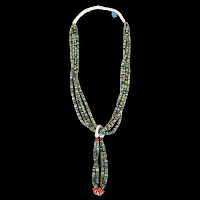
Traditional Santo Domingo Damele Turquoise Bead Necklace by Ray Lovato

Traditional Santo Domingo Damele Turquoise Bead Necklace by Ray Lovato.
The other day Ray Lovato, one of our favorite artists, stopped by and said he needed a little spending money for the grandbabies. At that point he retrieved this unusual Damele Turquoise necklace from his worn leather bag that is decades old.
After much discussion about what the grandkids needed and how rare the piece is, we made the deal. Afterwards we were both happy. Ray is always a pleasure, and always has great, museum quality, necklaces.
Wednesday, May 13, 2009
Morenci Turquoise

Morenci Turquoise
Morenci Turquoise; Arizona Mine, Morenci, Clifton - Morenci District, Shannon Moutnains, Greenlee County, Arizona, USA. An open pit copper mine located in the NΩ Section 16, T4S, R29E (Clifton 15 minute topographic map), owned by Phelps Dodge Corp. Map Reference: 33∞5; 26"N, 109∞21' 58"W.
Morenci turquoise was mined in southeastern Arizona until approximately 1990. It is located very near the New Mexico border, and ranges in color from classic high electric blue to light azure. Prehistoric Indians who valued the stone for its deep blue color were the first to discover the deposit. These people adorned themselves with rough hewn beads and carved talisman made from the mineral.
Morenci is often associated with an unusual black matrix of irregular iron pyrite, which looks metallic when polished. Although they are rare, stones with unusual birds-eye patterns, red matrix and an occasional layer of silver have also been found. The Morenci name is derived from the large open pit copper mine owned and operated by the Phelps Dodge Corporation. Early examples of this striking turquoise were of the "lunch box" variety, meaning they were carried out of the mine by workers and miners.
Morenci is well known; it was one of the first types of American turquoise to find its way to the market and is always difficult to obtain because the mine was depleted so long ago. It is believed that the best Morenci ever produced was discovered in the late 1960's to early 70's. During this time period, the mine produced a high, electric blue variety with iron pyrite inclusions. Since Morenci is no longer being mined, and because of its striking color and unusual matrix combinations, high grade natural Morenci is a valuable, highly collectible mineral.
USGS; Arizona.--In Arizona turquoise ranks first in terms of value of production and is also the best known of its gem materials. Nearly all important deposits of turquoise are located near copper occurrences or in copper deposits in arid desert regions of the world. Thus, the world famous turquoise deposits associated with certain of the large Arizona copper deposits are to be expected.
Turquoise is, or has been, mined from a number of these copper mines as a byproduct, usually by outside contractors. The financial and operating terms of the collecting contracts vary from mine to mine. Some of the operations are little more than the efforts of individual commercial collectors; some are essentially full-scale mining operations that are simultaneous with, but separate from, the regular mining operations; and still others operate on an on-call basis as turquoise is uncovered by the regular copper mining operation. Regardless of the size or sophistication of the initial mining or recovery operation, the actual turquoise is recovered by careful extraction using hand methods.
Friday, May 01, 2009
1970's Gem Grade Lander Blue Turquoise Ring

1970's Gem Grade Lander Blue Turquoise Ring
Talk about a flashback, features of this ring are truly reminiscent of the 1970's style of gold smithing. The overly large, hand stamped and filed leaves capped with a delicate flower and gold accent balls are classic features. A plain, notched bezel and a simple half-round shank clearly dates the piece. The only thing that might add to its aura would be a pair of bell-bottom pants and a paisley print acrylic shirt. What makes this 14 karat gold ring special is a highly unusual cabochon of gem-grade Lander Blue turquoise. Pitch black matrix surrounds islands of intense blue polka dots. This is the rarest and most valuable turquoise ever mined. There are certain things that never go out of style, they simply get better with age; Lander Blue turquoise is surely one of those things.
Friday, April 24, 2009
Navajo Jewelry

Navajo Jewelry
Contemporary Navajo jewelry shows dynamism and innovation as modern artists build on the foundation of early silversmithing techniques. Top Navajo jewelry artists pay homage to the techniques of the past while pushing into new expressions with exotic metals and stones gleaned from around the world. The culmination is an array of jewelry expression from classic Navajo concho belts and bracelets to modern forms expressed in precious metals and sparkling gems.
Navajo metalsmiths were not only responsible for the inception of Navajo jewelry, but the introduction of silversmithing to Hopi and Zuni artisans. One of the most prominent early Navajo jewelry silversmiths, Atsidi Sani, learned metalsmithing techniques from a Mexican man living near Mount Taylor, New Mexico. He is often credited with the emergence of Navajo silver jewelry, first by teaching his four sons and they in turn, teaching others in the newly formed Navajo Nation.
Early Navajo jewelry consisted of simple earrings, ketohs, belt fasteners and bracelets. Traders provided tools and supplies such as silver coins and slugs. More important, traders gave Indian silversmiths a place to trade and sell their work. In the 1920’s sheet silver replaced silver slugs, allowing artists to work more quickly since they no longer needed to melt and pound the slugs flat. A Navajo jewelry style evolved, typified by heavy silverwork hammered, bent and molded, either alone or sometimes around stones.
----Excerpt from A Guide To Indian Jewelry in the Southwest by Georgiana Kennedy Simpson
Thursday, April 23, 2009
1950's Handspun Beautiful Border Yei Rug

1950s Handspun Beautiful Border Yei Rug
"This is a beautiful hand-spun weaving. Woven in the 1950s, it has that special patina that comes after being carefully loved for many decades. This rug will look look great in any home."
Friday, April 17, 2009
Navajo Gold and Paiute Turquoise Bracelet by Toby Henderson

Navajo Gold and Paiute Turquoise
Bracelet by Toby Henderson
"The soft warm glow of 14K gold and contrasting electric blue of this natural gem grade Paiute turquoise come together beautifully in this remarkable bracelet. Navajo artist Toby Henderson is skilled in the fashioning of traditional Navajo-style jewelry. His clean lines and refined finish allow for a simple yet elegant presentation. The quality materials used in this bracelet are essential in creating a highly collectable art piece. You just can't go wrong with this one."
Friday, September 19, 2008
Navajo Double Stone Morenci Turquoise Bracelet by Navajo Silversmith John Begay Jr.

"In my opinion, John Begay Jr. is one of the best classic silversmiths working today. His attention to detail is astounding. Look closely at the workmanship on this bracelet and you will be amazed, as I am, at the quality. The degree of difficulty in this bracelet is much higher than your average Joe Silversmith can hope to accomplish. Sitting atop this beautifully crafted cuff is a pair of intense blue Morenci cabachons with black dendritic looking matrix patterns. You wanna' talk about attractive, these perfectly matched, twin stones are it. This bracelet set with these stones are superb; museum-quality at least." - Barry Simpson Twin Rocks Trading Post
Monday, March 17, 2008
Zuni Fetishes

Collecting Zuni fetishes is highly personal. Speak to one collector and he will tell you about each carving's personality. Another may speak of her attraction to the realistic Zuni carvings of the Cheama family. Yet another may enjoy the humor in Leonard Halate's dinosaur carvings. Whatever the attraction, collecting Zuni fetishes is extremely popular. For many who wish to enjoy the beauty of Native American art but are limited in budget or space, Zuni fetish collecting is the perfect solution.
Talismans have been a part of cultures throughout the world. Archaeologists have found figures at sites scattered around the globe. A fetish is an object, natural or man-made, in which a spirit is thought to reside and which can be used to effect either good or evil. The word fetish comes from the Portuguese word "feitico" which comes from the Latin word "facticus" which means artificially produced. For the purposes of this discussion, when we speak of fetishes, we are referring to the animals carved for the consumer market by the people of the southwestern Pueblo cultures. A few carvers produce fetishes at other Pueblo villages, but the majority of Native American fetish carvings made for the consumer market today are produced by Zuni carvers.
Navajo people use fetishes as well. Navajo fetish use concentrates most often on protection animals for their livestock. Navajo uranium miners were known to carry badger and mole fetishes for protection. Often Navajos will acquire a pueblo fetish for their personal use rather than making their own. The vast majority of animal carvings made by Navajo carvers are for the consumer market. --- edited by the author, Georgiana Kennedy Simpson from her original text featured in the book, Collecting Authentic Indian Arts & Crafts.
Friday, October 05, 2007
Blue Gem Turquoise Cabochons

Blue Gem turquoise Cabochons are rare, valuable and historic American treasures. Quality Blue Gem turquoise is gifted with a wide range of color all of which are striking, full of wonder and pleasing to the eye. Because Blue Gem turquoise cabochons are very hard, a high polish is associated with this stone and unlike most turquoise, they don't easily change color. Very little large material ever came out of the Blue Gem mine. The majority found was small 1-mm "bleeder" veins and tiny nuggets which were perfect for Zuni inlay as well as their fine needlepoint and petitpoint jewelry. Blue Gem turquoise was very popular in the late 1930's and 40's and was commonly used in the Fred Harvey "tourist jewelry" that is so collectable today.
The Blue Gem turquoise deposit was first noted by Duke Goff in 1934. It was subsequently leased from the Copper Canyon Mining Co. by the American Gem Co. of San Gabriel, CA., owned by Doc Wilson and his sons, Del and William. The company operated the property until 1941 when the outbreak of the war caused a shortage of experienced miners. Both Del and William Wilson were called into the Army for the duration of the war, thus forcing the mine to close. Subsequently, the lease was allowed to lapse and work was abandoned. In 1950, the mine was leased by Lee Hand and Alvin Layton of Battle Mountain.
Production of turquoise at the Blue Gem lease in the early days of the operation was enormous. Although there is no exact information, it is reported that the output amounted to nearly $1 million in rough turquoise. The mine is still active, although it is currently in the center of a major copper deposit being developed by Duval Corp.
The Blue Gem mine was at one time located deep underground, accessed by tunnels descending as far as 800 feet. This is of interest because the Blue Gem Mine and the Bisbee Mine in Arizona are the only two mines (of which we are aware) that turquoise was found that deep in the earth. The Blue Gem mine was once consisted of extensive underground workings and open stopes. An adit several hundred feet long on the main structure connected to numerous shorter tunnels and several open stopes. Directly above the main adit was a glory hole some 100 feet long.
Blue Gem turquoise occurs in argillized quartz monzonite cut by two limonite-stained sheer zones, one trending N. 35 o W . and dipping 75 o NE., the other trending N, 25 o E. and dipping 55 o NW. An extensive breccia zone about 10 feet wide is developed between the two bounding sheers. Exceptionally good quality turquoise forms veinlets up to three-quarters of an inch thick along the shears. Pyrite-bearing quartz veins are closely associated with the turquoise and while pyrite in Blue Gem is unusual to see, it is not unheard of.
Blue Gem turquoise remains some of the finest turquoise ever found, and unlike most turquoise mines, (in which the majority mined is chalky and only usable if stabilized) most of the turquoise found there is of a gem-quality grade. Today the Blue Gem mine is not viable because it sits in the middle of a huge mining operation. The emphasis at the surrounding mine is on precious metals and the extraction of turquoise is considered a hindrance in the mining process. The ever popular "Dump Diving" for turquoise through the overburden is not tolerated due to the very real danger of becoming buried in a slide. Insurance factors, equipment hazards, high explosives and safety issues along with a lack of interest from the mining company keep Blue Gem turquoise unavailable to the world, at least for now.
At Twin Rocks Trading Post, we possess a deep love for great American turquoise. Visit us under the red rock twins and we will teach you about the joys of collecting turquoise.Sunday, September 16, 2007
Santa Domingo Jewelry

While contemporary Indian jewelry has followed many paths, the work most closely linked to the jewelry creations of ancestral Puebloans is the stone and shell necklaces, pendants, rings and bracelets produced at Santa Domingo Pueblo in New Mexico. Ray Lovato’s heishi necklaces and flat stone earrings provide one of the best modern examples of how ancient Puebloan jewelry looked.
When stone merchants come to the village, competition for turquoise and other materials is fierce. Using five-gallon cans for chairs, Santa Domingo women arrange themselves around tables piled with stones and shells to individually pick the raw materials they will shape into their jewelry.
Discoidal bead necklaces known as heishi require rough-cut stones which are first drilled, usually with electric drills and grinding machines, and then strung on a wire. Next the artist holds both ends of a wire strand and carefully draws the beads back and forth across a grinding wheel or other rough surface, shaping the heishi. The diameter of the beads can be very fine or more substantial. The artist then strings the beads on a softer cord such as cotton. Formed this way, good Santa Domingo heishi should feel uniform and smooth to the touch when running your fingers along the beads.
Be aware that some stone merchants provide polished and drilled stones with foreign-made shell beads for stringing. The unscrupulous will simply string these materials and offer the result as authentic handmade jewelry. Beware of necklaces where beads do not fit into each other and feel rough when you run your hands down the string of disks. They do not demonstrate the fit of a proper Santa Domingo necklace.
Mosaic inlay is still prevalent among several families at Santa Domingo Pueblo. Traditional backings - wood or shell - gave way to experimental materials such as phonograph records or car batteries in the early half of the twentieth century. Today shell is widely used as a backing. Santa Domingo artists may leave the shells in their natural form or trim them to a certain shape. As with other types of Puebloan mosaic inlay, the artist then creates a design or pattern on the backing with many varied-sized stones. Santa Domingo mosaic work tends to be more abstract in design than the geometric and pictorial mosaics of Zuni artists.
Monday, August 27, 2007
Navajo Jewelry

Contemporary Navajo jewelry shows dynamism and innovation as modern artists build on the foundation of early silversmithing techniques. Top Navajo jewelry artists pay homage to the techniques of the past while pushing into new expressions with exotic metals and stones gleaned from around the world. The culmination is an array of jewelry expression from classic Navajo concho belts and bracelets to modern forms expressed in precious metals and sparkling gems.
Navajo metalsmiths were not only responsible for the inception of Navajo jewelry, but the introduction of silversmithing to Hopi and Zuni artisans. One of the most prominent early Navajo jewelry silversmiths, Atsidi Sani, learned metalsmithing techniques from a Mexican man living near Mount Taylor, New Mexico. He is often credited with the emergence of Navajo silver jewelry, first by teaching his four sons and they in turn, teaching others in the newly formed Navajo Nation.
Early Navajo jewelry consisted of simple earrings, ketohs, belt fasteners and bracelets. Traders provided tools and supplies such as silver coins and slugs. More important, traders gave Indian silversmiths a place to trade and sell their work. In the 1920’s sheet silver replaced silver slugs, allowing artists to work more quickly since they no longer needed to melt and pound the slugs flat. A Navajo jewelry style evolved, typified by heavy silverwork hammered, bent and molded, either alone or sometimes around stones.
One early technique still used by Navajo silversmiths is making silver castings in sand or stone molds. The artist carves a design into damp sand or tufa, a porous volcanic stone, and then secures a second flat stone on top to complete the mold. Using a crucible, the artist then pours melted silver into the mold through a carved channel. Air vents allow steam to escape, preventing air bubbles from forming in the cooling silver.
After the silver has cooled and hardened, the artist removes the piece from the mold. Any silver not part of the overall design is cut off and the edges are filed smooth. All surfaces of the jewelry are ground and polished. Sometimes, artists add stones as a final accent.
Early Navajo jewelry emerged from blacksmithing techniques that required the heating and softening of metal interspersed with hammering to work the metal into desired shapes. Great skill is required to balance these opposite forces. Too much heating and hammering causes the piece to become “work-hardened” making it brittle and prone to cracking. Too little force can lead to a poorly shaped piece with shallow, inconsistent design work.
After shaping the piece, the silversmith uses a graver or die stamps to inscribe designs into the metal. Many artists create their own carved metal stamps to add design elements such as lines or swirls to their jewelry. The artist places the designed end on the desired spot of the jewelry piece then strikes, stamping the design into the metal surface. A good silversmith strikes the stamp evenly each time, producing a consistent design.
----Excerpt from A Guide To Indian Jewelry in the Southwest by Georgiana Kennedy Simpson
Wednesday, August 22, 2007
Navajo Baskets

Navajo baskets possess a rich history, indicative of the Navajo people’s movement into the Southwest and their subsequent adoption of a lifestyle which would best help them survive in the high red rock desert of the American Southwest. Interestingly, Navajo baskets today descend from basketmaking techniques adopted from Ancestral Puebloan people. As is true with other Navajo art forms perfected by rug weavers and silversmiths, Navajo basket artists have mastered techniques necessary to create fine baskets with a uniquely Navajo flavor.
All Navajo baskets employ the coil method of weaving using rhus trilobata, more commonly known as three-leaf sumac. The foundation for all designs is the Navajo ceremonial basket which continues to be woven and used in traditional Navajo healing rites. In the late 1960’s, a few Navajo basket weavers experimented with other pictorial elements such as yei’i and eagles. As a result of this early experimentation, Navajo basket artistry is currently experiencing its richest period of innovation. Led by fine basket technicians and artisans such as Elsie Holiday, Lorraine Black, Alicia Nelson and Joann Johnson, a plethora of representational and geometric designs is making contemporary Navajo basketry one of the most exciting expressions in contemporary Native American art.
Saturday, August 11, 2007
Hopi Jewelry

Hopi jewelry, although a somewhat latecomer to the southwestern silver jewelry pantheon is widely and wildly collected by enthusiasts of clean designs executed in gold and silver. At Twin Rocks Trading Post, our love of fine Native American artwork spills into a top selection of contemporary Hopi silver jewelry. Visitors venturing to our store located in Bluff, Utah’s beautiful red rock river valley will find a large assortment of Hopi silver overlay bracelets, earrings, pins, buckles, and pendants.
Hopi jewelry created from shell, wood, bone and stones, including turquoise, has been created at their ancient villages for many centuries. The village of Orayvi is considered the oldest continuously inhabited community in North America and beautiful renditions of ancient jewelry as well as ongoing traditions in painting, basket making and cloth weaving laid a rich foundation for a wholly new Hopi jewelry art form.
In the late 1930’s, curators from the Museum of Northern Arizona encouraged Hopi artists to create their own unique style to differentiate their work from the Navajo and Zuni jewelry being made at that time. Using designs from Hopi pottery, baskets, weaving and paintings, artists Paul Saufkie and Fred Kabotie created classic interpretations to be executed in Hopi silver.
Paul Saufkie (1898 - 1933) learned silversmithing in the 1920’s and after World War II, in a program sponsored by the G.I. Bill of Rights, taught returning Hopi veterans the art of Hopi overlay jewelry. One of their first and most successful students, Victor Coochwytewa, developed a new technique whereby the bottom silver layer is oxidized, allowing the cutout designs in the top layer to show more prominently, a technique still in use today. In 1949, Paul, along with Fred Kabotie, formed the Hopi Silvercraft Cooperative Guild, providing training, materials, financing, work space and marketing for a growing Hopi silver jewelry market.
Today, contemporary Hopi artists continually refine their techniques while finding new ways of expressing these beautiful designs for discriminating buyers in Native American art. Travel down U.S. Highway 191 and visit two of the best locations in the Southwest; Twin Rocks Trading Post and Bluff, Utah.